
Toward a Zero-Barrier Innovation Economy
John McDonald, President and CEO, Northeast Indiana Innovation Community
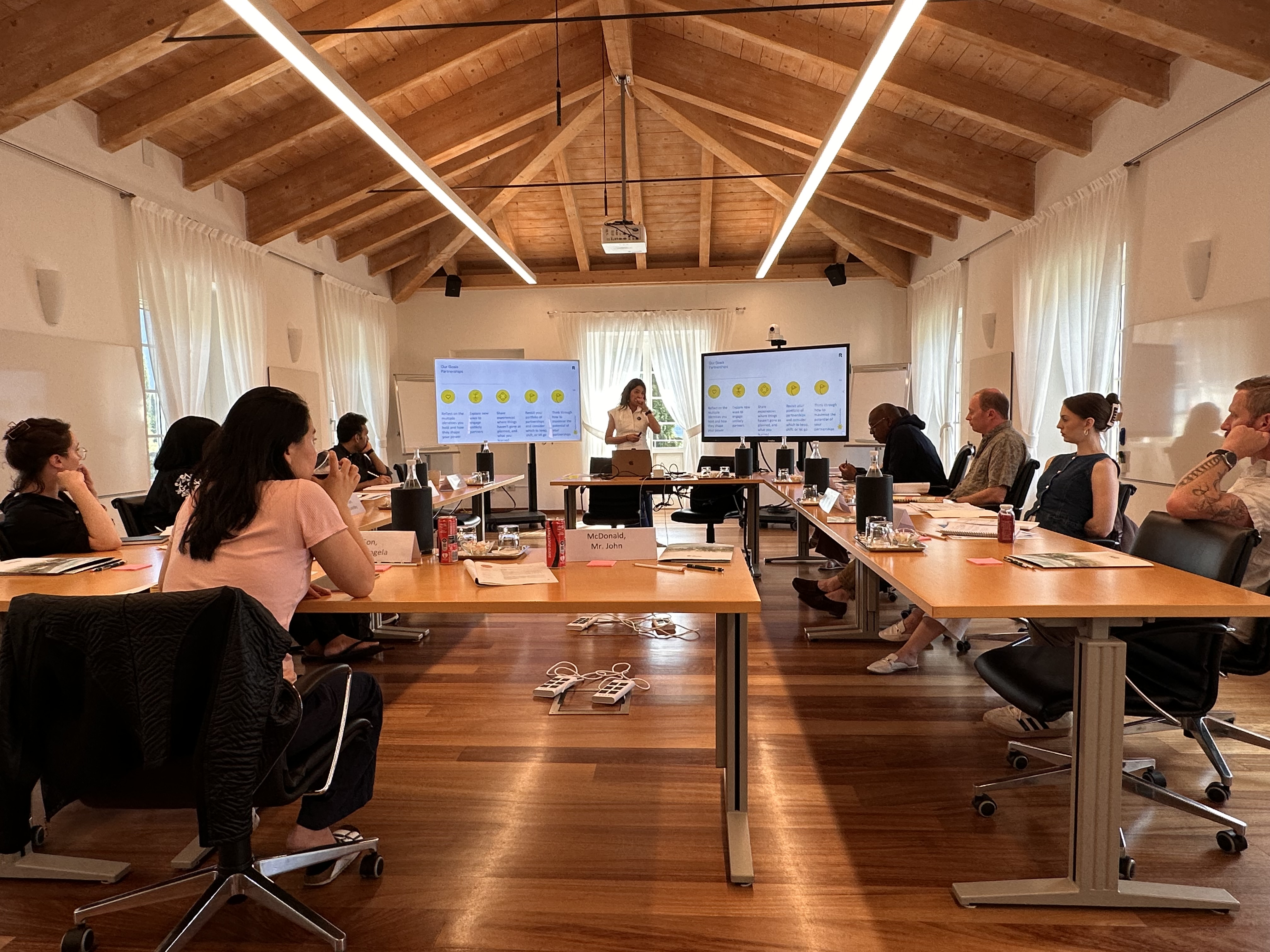
I recently travelled from Fort Wayne to Lake Como in Italy with what I thought was a pretty big idea. I was selected to participate in the Rockefeller Foundation’s Big Bets Fellowship, which brought a cohort together at their Bellagio Center in northern Italy to challenge, sharpen, and expand the bets we had brought with us. With just ten members selected from more than 2,000 applicants, it was a true honor for Northeast Indiana and our work to be included.
Bellagio is an unusually good place to think, in no small part because of the place itself. It is hard not to gain perspective when looking out over Lake Como from a patio nestled in the Italian Alps, yet that wasn’t enough. The Rockefeller Foundation team created an expertly designed experience around a small cohort of people working on very different, very big problems, with enough structure to push our thinking and enough unstructured time to let the conversations go wherever they needed to go.
Even my room seemed designed for reflection. I stayed in a beautifully restored old friary with a chapel and 24-hour refreshments, but no televisions and very few distractions. Between the setting, the conversations, long meals, walks, and time simply to think, the week began to feel less like an event and more like a mini sabbatical.

My candidacy for the Fellowship stemmed from our Problems to Prosperity: A New System for Innovation-Driven Job Creation strategy. Its premise is that some of the greatest untapped economic assets in communities like Northeast Indiana are the thousands of valuable problems hiding in plain sight inside our existing companies. Every day, manufacturers, healthcare organizations, logistics companies, farms, and other employers encounter problems they want to solve. Too often those problems remain inside the walls of the company experiencing them, while somewhere else an entrepreneur is searching for an idea worth building a company around, and faculty members at our higher education institutions are searching for meaningful opportunities to engage.
That strategy asks: What if we deliberately connected them in community? What if, instead of asking entrepreneurs to dream up businesses in isolation, we exposed them to real problems with real customers attached? What if, instead of pursuing knowledge for knowledge’s sake, we empowered our deep technical experts to solve local technical challenges? Could we turn those problems into new products, new companies, and ultimately new jobs? Could entrepreneurship become not simply a startup activity, but a much more intentional engine of regional economic growth?
I firmly believe this thesis accounts not only for the interest of an international foundation in our work but also serves as the baseline for the work ahead. But given the time and space to really pull at the threads of the idea, something started whispering, then shouting, in my head.
I had been thinking primarily about how we could create a better connection between problems and the people capable of solving them, and what that could mean for economic development strategies and results. Increasingly, though, I found myself wondering whether the much bigger story was what has happened to the cost of solving problems in the first place, and what that means for us locally.
See, for most of modern economic history, turning an idea into something real required access to things most people simply didn’t have: information, specialized expertise, sophisticated tools, technical infrastructure, significant capital, and networks of people capable of helping move an idea forward. Those barriers did more than determine which ideas got built; they helped determine who could become an innovator, where innovation happened, and where the prosperity it created was captured.
But even during my lifetime, one technological wave after another has been knocking those barriers down. The Internet radically democratized access to information, communication, and collaboration. The cloud democratized access to computing and technical infrastructure. Today, artificial intelligence is beginning to democratize access to ideation, prototyping, and testing. Put those three things together, and something remarkable begins to happen: the cost of getting from problem to working prototype asymptotically approaches zero.
That doesn’t mean innovation becomes effortless or that every idea becomes good. But it does mean that something that has been scarce throughout almost all of economic history, namely the ability of an ordinary person with a problem and an idea to actually build and test a solution, is becoming extraordinarily abundant.
And, if true, that raises a much bigger question than the one I brought with me to Italy with my clean clothes: What happens to an innovation economy when creating the prototype is no longer the bottleneck?
Northeast Indiana has been through a technological transformation like this before. In fact, there was a time when places like ours weren’t trying to figure out how to participate in somebody else’s innovation economy, because we were helping invent it.
I went to Bellagio thinking about how we might turn more of our problems into prosperity, but came home wondering whether we have an opportunity to do something much bigger.
But to go forward, let’s go backward.
We Have Been Here Before
It is easy to think about innovation today as something that happens somewhere else, in role models like Silicon Valley, Boston, Austin, and Seattle. These are places where you abundantly find venture capital firms, research universities, innovation-driven corporations, and people wearing hoodies to investor meetings, but there was a time when Northeast Indiana was one of those places (without the hoodies).
To understand how we got there, it helps to go back a little further.
America’s Industrial Revolution began largely in New England around the turn of the nineteenth century. Early factories, particularly textile mills, clustered there around flowing water that could power machinery, established ports and commercial centers, available labor, and capital. At first, geography placed very real limits on where industry could operate, but then transportation began changing that equation.
Canals, steamboats, and then railroads connected the rapidly expanding interior of the country to eastern markets. Agricultural products, timber, coal, iron ore, and other raw materials could move increasingly long distances at economically viable costs. In the other direction came finished goods, machinery, people, and capital. By the middle of the nineteenth century, railroads were beginning to turn what had been a collection of relatively isolated regional economies into something approaching a national market.

After the Civil War, that transformation accelerated dramatically into what historians often call the Second Industrial Revolution. The first transcontinental railroad was completed in 1869, and between 1871 and 1900 the United States added roughly 170,000 miles of railroad track. The industrial economy was no longer tethered primarily to the old manufacturing centers of the Northeast. Increasingly, it made economic sense to locate production closer to the raw materials, transportation networks, workers, and rapidly growing markets of the interior, and the Great Lakes and Midwest were particularly well positioned for what came next.
Iron ore could move from Minnesota and Michigan, and coal from Appalachia and the Midwest. Timber, grain, livestock, petroleum, and other resources flowed through a rapidly expanding network of railroads, rivers, canals, and Great Lakes shipping. Chicago became the great transportation hub of the interior. Pittsburgh became synonymous with steel. Cleveland became a center of petroleum refining and manufacturing. Detroit would become the center of the automobile industry.
Northeast Indiana sat directly in the middle of this emerging industrial system. What followed here wasn’t simply the arrival of factories, but the creation of companies and entire industries. Jenney Electric grew from the work of local inventors and entrepreneurs during the emergence of commercial electrical power and eventually became part of General Electric. A generation later, Dudlo Manufacturing helped establish Fort Wayne as a center of the magnet-wire industry by developing improved enamel-insulated wire critical to electric motors, appliances, automobiles, and industrial machinery. After moving to Fort Wayne, Magnavox pioneered advances in stereophonic sound and later introduced the Odyssey, the first home video-game console. Philo Farnsworth brought his television company and continued development of electronic television here. Companies involved in transportation, machinery, electrical equipment, and manufacturing grew alongside them. Even a young Thomas Edison spent two months working as a railroad telegrapher in Fort Wayne.

It was truly yesterday’s version of an “innovation ecosystem.” There were important problems to solve, technically capable people trying to solve them, and access to customers willing to buy the solutions. More importantly, there was capital willing to finance businesses before their outcomes were certain, factories capable of producing what those businesses invented, and a growing labor market capable of scaling production.
Problems. Solutions. Markets. Capital. Talent.
Those elements reinforced one another, and it was happening throughout the industrial Midwest. John D. Rockefeller didn’t inherit an oil industry that looked anything like the one we know today, but helped create one. Henry Ford didn’t simply make an existing automobile company more efficient, but helped turn an expensive novelty into a mass-market product and reorganized manufacturing around it. Andrew Carnegie didn’t just create an enormous enterprise around rapidly evolving steel-production technology, but literally provided the materials to build America.
We call them industrialists today, but it is useful to think about what they actually were at the time: the entrepreneurs, innovators, financiers, and risk-takers building businesses around emerging technologies and markets whose ultimate potential was still unknown. They were, in many respects, the Elon Musk, Steve Jobs, and Jeff Bezos of their age.
The result was an extraordinary concentration of economic creation across the Great Lakes and industrial Midwest. New technologies created new companies, then new companies built factories, then factories created jobs, then those jobs honed skills. Suppliers emerged around the successful companies, wealth was created and reinvested, and universities and institutions grew alongside them.
Manufacturing jobs were not the beginning of that economic-development process. Manufacturing jobs were the payoff.
Before thousands of people could be employed making something, someone had to identify a problem, imagine a new solution, build it, finance it, find a market for it, and then acquire the people and capital necessary to produce it at scale. The result? “Good” jobs that allowed people to build a life and support a family, courtesy of the innovation process.
Northeast Indiana didn’t just make things: we made things happen.

When Innovation Moved Away
By the middle of the twentieth century, new technologies that would drive the next great transformation of the American economy were beginning to emerge. The transistor, integrated circuits, computers, and software were creating an information economy whose center of gravity increasingly shifted toward Northern California. Stanford University, federal defense and research spending, emerging semiconductor companies like Fairchild and Intel, and a growing concentration of technical talent all contributed to what would become known as Silicon Valley.
Alongside those technologies grew something equally important: a new kind of capital designed specifically to finance disruptive innovation. The modern American venture-capital industry took shape alongside the information economy in the 1960s and 1970s, developing an investment model suited to companies with enormous uncertainty, limited operating histories, few tangible assets, and the possibility of extraordinary growth. Traditional lenders understandably wanted to know whether a company could repay its debt, while mature corporations increasingly evaluated investments against predictable returns. Venture capital could ask a fundamentally different question: “What if this works?” Its portfolio model accepted that many uncertain bets would fail because the few that succeeded could produce extraordinary returns.
The Midwest did not stop innovating, but the kind of innovation at the center of our economy changed. Think of innovation along two dimensions: from existing to new solutions, and from existing to new markets. An existing solution for an existing market is incremental innovation: making what we already do cheaper, faster, better, or more efficient. Taking an existing solution into new markets is sustaining innovation. Organizations cannot assume today’s customers will be tomorrow’s customers, so they must continually find new markets for what they already know how to do. A new solution introduced into an existing market is radical innovation, changing what we offer customers and potentially the nature of our relationship with them. But the greatest uncertainty lies in the upper-right corner: a new solution aimed at a new or not-yet-understood market. That is disruptive innovation, where entirely new products, companies, and industries can emerge. This quadrant is not where new startups evolve to. It is where they begin.

The Rockefellers, Fords, Carnegies, and other industrial entrepreneurs of the previous era lived in that upper-right corner. Petroleum, automobiles, commercial electricity, and modern steel production were not established markets waiting for someone to make them five percent more efficient. These entrepreneurs were making enormous bets on technologies and markets whose ultimate potential was unknown. But as their companies and industries matured, their responsibilities changed. A large manufacturer has factories to keep running, customers to satisfy, employees to pay, and owners expecting returns. Its capital rationally gravitates toward investments whose outcomes can be measured. The questions evolve from, “What could we build that has never existed before?” to “How can we make what we already have cheaper, faster, and better?”
The industrial Midwest developed extraordinary capabilities in manufacturing engineering, process improvement, automation, quality, logistics, and operational efficiency. At the same time, Silicon Valley was developing a financial system specifically designed to tolerate the uncertainty of the upper-right corner. Over several decades, the people, experience, relationships, and institutions necessary for disruptive innovation increasingly accumulated around it. The two regions diverged: the Midwest became extraordinarily good at making known things cheaper, faster, better, and at enormous scale, while Silicon Valley became the new home for financing people who wanted to make things that had never existed before.
And then globalization arrived, not all at once, but beginning in the 1970s and accelerating through the decades that followed. Improvements in transportation, communications, trade, and global supply chains made it increasingly practical to manufacture products almost anywhere in the world. For an industrial Midwest that had become extraordinarily good at making known things cheaper, faster, and better, this created an entirely new kind of competition. Suddenly, “cheaper” might mean making something somewhere else where labor cost a fraction as much. “Faster” might mean redesigning a global supply chain to move far-flung production efficiently around the world. “Better” was not a market the Midwest had cornered, nor was it enough to guarantee that production, or the jobs attached to it, would remain here. A region that had once been one of the greatest concentrations of innovation and economic creation in the world became known to that world as the Rust Belt.

Our response was understandable. If jobs were disappearing, communities needed to replace them, and the modern economic-development profession grew increasingly focused on doing exactly that. States and regions built industrial parks, prepared sites, invested in infrastructure and workforce development, offered tax incentives, recruited companies, and competed aggressively for expansions and relocations. Retaining an existing employer or convincing an outside company to build its next factory in your community could mean hundreds or thousands of jobs.
But moving jobs from somewhere else is not the same as creating them. While business attraction, retention, infrastructure, and workforce development are important parts of a healthy regional economy, they largely operate after the most important acts of economic creation have already occurred. Someone, somewhere, has already identified the problem, developed the solution, built the business model, found the market, raised the capital, and created the company. By the time communities compete over where that company will locate its production, they are competing for the economic output of an innovation process that has already happened somewhere else.
For decades, traditional economic development was a rational response to the economic realities we faced. Many of the resources required to participate in disruptive innovation were concentrated somewhere else. Technical expertise, computing infrastructure, information, networks, and risk capital were not equally available everywhere, and recreating a Silicon Valley-style innovation ecosystem from scratch was beyond the means of most communities.
But that instinct to find a better way to solve problems never left.
And Then the Barriers Began to Fall
While communities like ours were becoming increasingly focused on competing for the outputs of innovation, something remarkable was beginning to happen to the inputs. The same information technologies that had helped create enormous concentrations of wealth and innovation in places like Silicon Valley began, one by one, to make geography less important to the process of creating something new.
The Internet was the first barrier destroyer. Before it, access to information, expertise, customers, collaborators, and even basic knowledge about markets was expensive and unevenly distributed. Where you lived and who you knew mattered enormously. The Internet did not eliminate those advantages, but it dramatically reduced them. Suddenly, a would-be entrepreneur anywhere could access technical information, research markets, find suppliers, communicate with experts, reach potential customers, and collaborate with people around the world at a cost approaching zero. Information that once required proximity to a university, large corporation, specialized network, or major commercial center increasingly became available to anyone with a connection.
Then the cloud began doing something similar to computing infrastructure. Building a technology capability once required substantial upfront investment simply to acquire the computing power necessary to operate it, for startups and established corporations alike. Servers had to be purchased, software licensed, data centers built or leased, and technical people hired to maintain all of it. Cloud computing transformed much of that fixed cost into a variable one. An innovator no longer needed to own the infrastructure required to test an idea at scale. Computing power that had once been available primarily to large companies and well-funded startups could increasingly be rented by almost anyone, often at near-zero cost at the beginning, especially from cloud companies courting startups. Cloud was not a technical revolution so much as a procurement democratization.
Together, the Internet and cloud removed enormous barriers, and the cost of starting a company fell with them. But an important barrier remained: the ability to actually build a solution to a problem well enough to test it with potential buyers. Having access to information did not make you a software engineer, just as cloud credits did not mean you knew how to write code, design a product, analyze data, create a user experience, or connect all of those pieces into something that worked. Technical talent remained expensive, specialized, and disproportionately concentrated in the same places where technology companies and venture capital had accumulated.
But now, artificial intelligence is attacking that barrier, too. Generative and agentic AI are rapidly changing what an individual or very small team can create without possessing all of the technical expertise that creation previously required. Someone who understands a problem deeply can increasingly describe what they want, interrogate possible solutions, generate software, analyze data, design interfaces, create content, test assumptions, and assemble working prototypes using tools that cost little or nothing.
There is an important irony in all of this. The companies building these enormous technology platforms have every economic incentive to democratize access to them. Their greatest opportunity is not to preserve the scarcity that made the previous generation of technology valuable, but to destroy it. Cloud providers benefited by making ownership of computing infrastructure increasingly unnecessary, because every new experiment could become tomorrow’s enormous computing customer. AI platforms have an even greater incentive to reduce the technical expertise required to create something, because every additional person they enable to build, test, and deploy a solution becomes a potential consumer of their models, computing power, agents, and services. The winners in these platform transitions tend to be those most willing to make their previous source of scarcity worthless, while incumbents that protect the golden goose of the last platform risk watching someone else create the next one. As a result, some of the largest and best-capitalized companies in the world are now competing to drive down the cost and expertise required to turn an idea into a working solution.
That is enormous.
For most of the information economy, disruptive innovation has been most expensive at precisely the moment of greatest uncertainty. Before knowing whether customers wanted a solution, an entrepreneur often needed technical talent, infrastructure, time, and capital simply to build enough of it to find out. That economic reality helped produce the venture-capital model described earlier. If getting to an answer requires millions of dollars, someone has to finance the question, and if many of those questions will produce the answer “no,” the few that produce a “yes” need to become extraordinarily valuable to compensate for all the failures.
But if the venture-capital model evolved, at least in part, around the enormous upfront cost and risk of discovering whether new solution for a new market could work, what happens to that model when the cost of making that discovery collapses?
What happens when someone encounters a problem on a factory floor in Auburn, a hospital in Fort Wayne, or a farm in rural Northeast Indiana and can build and test a credible solution without first assembling a technical team or raising hundreds of thousands of dollars? What happens when the cost of moving from problem to working prototype asymptotically approaches zero?

That was the thought that kept following me around the paths of the Rockefeller Bellagio Center.
The Internet democratized access to information. The cloud democratized access to infrastructure. AI is beginning to democratize access to trial solutions. Each technological wave has removed another reason that the earliest stages of disruptive innovation needed to be concentrated in places where specialized resources and capital were abundant.
That does not mean geography no longer matters, or that every barrier to innovation is disappearing. Quite the opposite. As the barriers at the beginning of the innovation process collapse, the barriers that remain become easier to see, and that may be where the opportunity for places like Northeast Indiana emerges.
When Prototypes Become Abundant
For most of the modern innovation economy, the ability to create a working prototype was itself a significant accomplishment. It required technical knowledge, time, infrastructure, and capital outside the reach of most. That scarcity acted as a natural filter on the number of ideas that could advance very far. Lots of people encountered problems, but far fewer could actually build something to solve them.
But what happens when that filter disappears? If the cost of moving from problem to trial solution continues collapsing, I think we should logically expect far more people to attempt it. Problems that would once have been tolerated because they were too small to justify the cost of developing a solution suddenly become worth exploring. Ideas that lived only on a whiteboard could become working prototypes in days or hours. A maintenance manager, nurse, logistics operator, farmer, accountant, engineer, or entrepreneur does not necessarily need to persuade someone else that a problem is important enough to fund before discovering whether a solution might work. It is the democratization of “try.”
That means we may be approaching an enormous innovation supply shock. Instead of a relatively small number of well-capitalized teams producing prototypes, we could have an order of magnitude more people creating and testing solutions to problems they understand firsthand. Many of those solutions will be terrible. Many will solve problems nobody cares enough about to pay for. Some will be technically impressive answers in search of a question. That is not a failure of the model; it is what abundance looks like. When experimentation becomes cheap, we can afford dramatically more experiments, discard the ones that do not work, and learn much earlier which ones deserve additional time and capital.
Yet I think there is another consequence that may be even more important for communities like ours: the economics of what constitutes a worthwhile innovation begin to change. Under the traditional venture model, expensive experimentation and high failure rates create enormous pressure to pursue enormous markets. If it takes millions of dollars to discover whether an idea works, the successful companies need the possibility of becoming very large to justify the risk and compensate for all of the unsuccessful investments around them. That naturally drives investors toward billion-dollar markets, exponential growth, and the small number of companies capable of producing extraordinary returns.
But imagine a problem shared by 500 manufacturing shops. It may never produce a billion-dollar company, nor interest a traditional venture fund at all. But if someone who deeply understands that problem can build a trial solution for almost nothing, find fifty customers who will pay for it, and grow a highly profitable company employing twenty, fifty, or a hundred people, why would we consider that an innovation failure? From the perspective of a regional economy, it may be an extraordinary success. Twenty companies employing fifty people each create a thousand jobs without requiring a single one of them to become a unicorn.
This opens an enormous territory between what we traditionally think of as a “small business” and what the venture industry considers a “venture-scale startup.” There are potentially thousands of valuable problems inside manufacturers, hospitals, farms, logistics companies, professional-services firms, local governments, and other organizations that have never represented large enough markets to support the historical cost and risk of developing solutions for them. As the cost of experimentation collapses, the minimum economically viable problem gets smaller with it.
This does not mean venture capital goes away. Some ideas will still require enormous amounts of capital to scale, particularly those involving advanced manufacturing, biotechnology, energy, semiconductors, and other physical technologies. The point is not that venture capital becomes obsolete, but that venture capital may no longer define the boundary of which technology businesses are worth creating.
That realization changed the question I had brought with me to Bellagio. I had been thinking about how we could help more people identify important problems and turn them into solutions. But if AI and the technologies that preceded it are dramatically increasing the number of people capable of doing exactly that, then creating solutions may no longer be the primary constraint. The bottleneck moved.
A working prototype is not a business, because someone still has to determine who will pay for it and why. A solution developed for one manufacturer has to find the other manufacturers that share the same problem. A founder has to develop a repeatable business model, reach customers, acquire the right kind of capital to grow, and eventually find the people capable of delivering the solution at scale. Those barriers do not disappear simply because the prototype became cheap. In fact, they become more important.
Yet I believe there is a real danger in getting this wrong. If we democratize the ability to create solutions without democratizing the pathways that allow those solutions to become companies, AI may simply enable millions more people to get farther before they fail. People who once lacked the technical capability to pursue an idea will suddenly be able to build it, test it, and see its potential, only to encounter the same old barriers to customers, business knowledge, capital, and talent. We will have created longer walks off shorter planks.
Worse, the benefits may continue flowing disproportionately to people who already possess the things AI cannot provide: relationships with potential customers, experience building companies, access to capital, and networks of people who can help them scale. AI access may become nearly universal while agency remains scarce. In that world, technology does not close the gap between people and communities that participate in economic creation and those that do not, but could actually widen it.
That is why eliminating the remaining barriers matters more, not less, as the cost of creating a solution falls. We could soon live in a world in which prototypes are abundant and pathways to commercialization are scarce. That means the need for communities like Northeast Indiana is not simply to help more people build things. The technology companies are already spending billions of dollars making that easier.
Our opportunity is to empower what comes next.
From Problems to Prosperity
If the bottleneck moved, then our work must move with it.
For decades, communities trying to participate in the innovation economy understandably focused on increasing the supply of entrepreneurs and startups. We built incubators, accelerators, pitch competitions, coworking spaces, mentorship programs, university commercialization offices, angel networks, and venture funds. Much of that infrastructure was designed for an economy in which the ability to create a technology company was itself scarce. Find promising entrepreneurs, help them develop their ideas, surround them with resources, and try to produce more startups.
But an innovation supply shock changes the problem. If dramatically more people can move from a problem to a credible trial solution without first raising money, finding a technical cofounder, or entering an entrepreneurship program, then our challenge is no longer simply producing more startups. It is creating a pathway through which promising solutions can continue moving toward economic impact.
I have started thinking about that pathway as a Zero-Barrier Innovation Economy.
“Zero barrier” is intentionally aspirational. There will always be friction, risk, competition, failure, and uncertainty in creating something new, and there should be. A Zero-Barrier Innovation Economy where every idea gets funded, every prototype becomes a company, and every company is protected from failure would be economically unserious. Markets should reject things customers do not value. Investors should decline opportunities that do not justify their risk. Companies that cannot create enough value to sustain themselves should fail. Those are not barriers; they are filters, and they are essential to a healthy innovation economy. The goal is not to eliminate failure. It is to identify each artificial discontinuity in the journey from problem to prosperity and ask whether it can be eliminated, democratized, or made dramatically cheaper.
Increasingly, technology is already doing some of that work for us. AI is attacking the cost of moving from problem to trial solution, creating the democratization of “try” described earlier. A person who understands a problem no longer necessarily needs all of the technical capabilities required to build the first version of its solution. That gets dramatically more people to the next question, “Can this solution become a business?”
That question introduces the business model, but even here the barrier is changing. The knowledge required to formulate and interrogate a business model has never been more accessible. Someone can use established frameworks and increasingly AI itself to identify possible customers, examine competitors, develop pricing hypotheses, model economics, explore channels, and design experiments around the assumptions that would have to be true for a business to work. But none of that proves there is a business, because eventually, another human being has to say something much more important:
“Yes, I have that problem, and I will pay you to solve it.”
That makes market access perhaps the most consequential remaining barrier. Building a solution for one machine shop does not create a company. The critical question is whether fifty, five hundred, or five thousand other machine shops share the same problem and whether you can find them. Historically, that has depended heavily on geography, relationships, reputation, sales capability, and luck. Someone with an established network begins with an enormous advantage, while someone without one can build exactly the same solution and never get it in front of the people who might buy it.
But something interesting may be happening to this barrier, too. The Internet connected us to essentially every potential customer in the world, but connection was never the same thing as access. Finding the right fifty people among billions remained extraordinarily difficult. AI may provide the missing layer between the two. It can increasingly help identify organizations likely to share a particular problem, find the people inside them responsible for it, research their circumstances, understand how the problem presents itself across markets, and dramatically reduce the cost of reaching and learning from potential customers. The Internet created the network. AI may make the network navigable.
That does not eliminate selling. It does not eliminate trust, reputation, relationships, or the need for a customer to actually say yes. Nor should it. Those are filters. But it may dramatically reduce the artificial advantage historically enjoyed by someone who simply happens to know the right people. If the Internet and AI together can democratize meaningful access to potential customers, something important happens next.
Market access enables the possibility of traction.
Traction is the hinge in this entire system. A founder with a working prototype and a theory about who might buy it remains highly speculative. A founder with a working prototype and customers actually paying for it has changed the question. We are no longer asking only, “Could this become a business?” We are beginning to ask, “How large could this demonstrated business become?”
And that changes the capital problem.
For much of the information economy, capital had to arrive near the beginning, when uncertainty was greatest. Investors financed technical teams and infrastructure so entrepreneurs could build products before anyone knew whether those products would work or whether customers would buy them. That enormous early risk helped create the venture model and its need for equally enormous potential returns.
But if problem-to-prototype becomes nearly free, business-model knowledge becomes broadly accessible, and market access becomes dramatically easier, capital can increasingly enter after much of that uncertainty has already been burned off. The founder is no longer necessarily asking someone to finance an experiment. The founder may be saying, “The product works, customers are buying it, and now I need capital to grow.”
Those are radically different risk propositions.
Capital does not disappear as a barrier, particularly for companies that need equipment, inventory, manufacturing capacity, regulatory approvals, sales teams, or other expensive resources to scale. But traction changes both the amount and kind of risk that capital is being asked to assume. That potentially opens the door to a much broader range of capital: angels, strategic investors, banks, customer financing, revenue-based financing, community investors, and venture capital where venture capital actually fits. The objective should not be to force every promising company into the venture model. It should be to connect a demonstrated opportunity with the right capital at the right time.
And once capital arrives behind demonstrated demand, it buys something that matters profoundly to economic development: capacity. Companies hire people, acquire equipment, manufacture products, build sales organizations, lease space, purchase services from other local companies, develop suppliers and train workers. Capital turns traction into productive capacity, and productive capacity creates jobs.
The sequence, then, looks something like this:
Problem > Trial Solution > Business Model > Market Access > Traction > Scale Capital > Talent & Capacity >Jobs > Prosperity
What makes this interesting is that each step reduces the uncertainty surrounding the next. We do not need to eliminate risk from the system. We need to stop forcing people to absorb risks earlier than necessary simply because they lack access to resources that technology or community can now make broadly available.
This also reveals something important about the economic-development model we built in response to the Rust Belt. Traditional business attraction enters this process extraordinarily late. By the time a community competes for a factory, headquarters, expansion, or hundreds of jobs, someone somewhere else has already identified the problem, created the solution, developed the business model, found the customers, demonstrated traction, raised the capital, and built the company. Economic development then competes over where the resulting productive capacity and jobs will locate.
What if we entered the process at the other end, which would be much closer to the economic system that created the industrial Midwest in the first place? Our great companies were not originally attracted here after someone else created them. People encountered problems, developed new solutions, built businesses around them, found markets, attracted capital, assembled productive capacity and talent, and created jobs. Manufacturing jobs were the payoff of that process, not its starting point.
For most communities, recreating that process around the technologies of the information economy would have been prohibitively expensive. The ingredients of disruptive innovation were scarce, costly, and geographically concentrated, but that is precisely what has changed. We do not need to recreate Silicon Valley in Northeast Indiana because the technologies that made Silicon Valley extraordinarily powerful are now helping dismantle some of the scarcity on which its geographic advantage was built.
Our opportunity is to do something different.
Imagine a community where encountering an important problem is enough to begin. Where the ability to test a solution is broadly accessible. Where someone who has never thought of themselves as an entrepreneur can learn whether a business exists around what they have created. Where potential customers become discoverable rather than inaccessible. Where traction allows capital to arrive after much of the earliest uncertainty has been removed. Where that capital helps locally rooted companies hire people, build capacity, and grow.
Not every idea would survive that journey. Most probably should not. But no promising idea should die simply because its creator did not know the right person, live in the right ZIP code, possess the right technical credential, or have access to the right kind of capital at the wrong moment.
That is the distinction between access and agency. Technology is rapidly democratizing access. Our job is to build the pathways that turn access into agency, but neither technology nor individual initiative alone will create a Zero-Barrier Innovation Economy. Technology can make experimentation extraordinarily cheap, knowledge broadly accessible, and networks increasingly navigable. It cannot guarantee that a customer will care, that a business model will work, that appropriate capital will appear, or that a company will successfully scale, nor should it.
What communities can do is deliberately organize around the places where artificial barriers remain.
That requires different thinking about the institutions we already have. Universities do not need to become venture funds to participate in disruptive innovation; perhaps their expertise needs to become easier for people solving local problems to reach. Established companies do not need to become startup accelerators; perhaps they can become sources of important problems and early markets for the solutions that emerge. Banks, investors, and philanthropic institutions do not need to finance raw speculation; perhaps new forms of capital can meet companies after traction has reduced the earliest risks. Economic-development organizations do not need to abandon business attraction, retention, infrastructure, or workforce development; perhaps they can also begin participating much earlier in the process that creates the companies and jobs they have historically worked so hard to attract.
None of those ideas requires us to invent a new Silicon Valley on the shores of the Maumee, St. Joe, and St. Mary’s rivers. In fact, that may be the point.

The Barrier Before the First Step
For much of the last half century, communities across the Midwest have looked toward the coasts and asked how we could acquire more of the ingredients concentrated there: venture capital, technical talent, startups, research commercialization, and the networks surrounding them. We built versions of their institutions, adopted their vocabulary, held their pitch competitions, created their accelerators, and celebrated when one of our companies raised money from one of their investors. There was nothing irrational about that, as those were the rules of the innovation economy we inherited.
But perhaps the more interesting question now is not how Northeast Indiana can become better at participating in their innovation economy, but what kind of innovation economy becomes possible when some of the scarcities that created theirs begin to disappear.
There may be one more barrier, though, and it may be harder to see because it exists in our own conception of ourselves. After decades of looking elsewhere for new technologies, new companies, venture capital, and the next great economic opportunity, it is possible to internalize the idea that innovation itself is something that happens somewhere else. We become the people who make things, improve things, and scale things other people invented, rather than people who expect to have a hand in imagining and creating what comes next.
That matters because every pathway described here still requires someone to take the first step. Technology can make a trial solution nearly free, but it cannot make someone believe a problem they have tolerated for ten years is theirs to solve. A community can make expertise, customers, and capital more accessible, but none of those things matter if the person who understands the problem best assumes that becoming an innovator is for someone with different credentials, different connections, or a different ZIP code. Perhaps the first barrier to an innovation economy is simply permission to try.
That is why recovering Northeast Indiana’s innovation history matters to me as more than nostalgia. We are not trying to convince ourselves that we can become something we have never been. We are remembering that creating new technologies, companies, industries, and prosperity was once as much a part of this region’s identity as manufacturing became later. Perhaps our time did not pass. Perhaps the economics changed, we adapted to them, and now they are changing again.
Coming Home
And that brings me back home. Northeast Indiana is not a place without innovation history trying to invent one. We are a place that once led in the entire process of economic creation, from problem through prosperity. Yet we transitioned to become extraordinarily good at manufacturing, improving, and scaling things whose markets and technologies were increasingly created elsewhere.
So, maybe the technologies and intentionality of this moment give us an opportunity to move upstream again, not by trying to recreate the industrial economy of the nineteenth century, nor by trying to replicate the venture economy of twentieth-century California, but by building an innovation system suited to the economics of the twenty-first century: one in which experimentation is abundant, small markets can support meaningful technology businesses, geography is less determinative of who gets to build, and communities deliberately connect solutions to the markets, capital, talent, and capacity necessary to turn them into prosperity.
That is a fundamentally different conception of economic development. It begins not with the question, “How many jobs can we attract?” but with a different one: “What problems can we empower our people to solve?”
I came to Bellagio believing that Northeast Indiana had important problems worth solving and that our approach could provide a pathway for similar communities across the Midwest. But I left believing those problems themselves may be among our most valuable economic assets. Every factory floor, hospital, farm, logistics operation, university laboratory, small business, and local government contains frustrations, inefficiencies, unmet needs, and ideas that have never been economically rational to pursue. Until recently, most of them probably deserved to remain that way. The cost of discovering whether a solution might work was simply too high relative to the potential value of solving the problem.
Yet I believe that calculation is changing. If the minimum economically viable problem is getting smaller, if the cost of trying a solution is approaching zero, and if the Internet and AI together can increasingly connect those solutions to the people who share the problem, then the raw material for the next generation of companies may already be all around us, hiding in plain sight as problems.
There was something fitting about arriving at this idea so far from home. From the terrace at Bellagio, looking across Lake Como toward the Alps, Northeast Indiana felt very far away. For a few days I was removed from the meetings, emails, budgets, grants, buildings, and a thousand small urgencies that normally fill my field of view. The old friary gave us something that is surprisingly difficult to find in ordinary life: enough distance to see the thing you are standing in the middle of. I had travelled more than four thousand miles to think about a problem back home, only to realize that what I had been looking for might already be there. The problems were there. The people who understood them were there. The companies, institutions, knowledge, capital, and talent were there, and increasingly the technology was there too. Perhaps what was missing was not another ingredient, but a different way of connecting the ones we already had.
The Big Bet I carried to Italy was that we could turn more of those problems into prosperity. I came home with a bigger one: that we could build a community in which anyone with a problem worth solving has a credible pathway to try.
That is economic agency, and if we can build that pathway here, perhaps Northeast Indiana does not need to wait for the next great company to choose us. Perhaps it is already here, hiding in plain sight as a problem worth solving.

Leave a Reply